Chapter 4 — What This Means
The first three chapters described Stockbridge as it is. Who lives here. What the town owns. How it got to this configuration. This chapter is about what that combination means — and about the Commonwealth’s December 2024 recognition of where Stockbridge has arrived.
A formal recognition
In December 2024, the Executive Office of Housing and Livable Communities designated 25 Massachusetts communities as Seasonal Communities under the 2024 Affordable Homes Act. The designation applied automatically to municipalities meeting statutory thresholds — primarily a seasonal-housing share above 40% in Berkshire County. Eight Berkshire towns were on the original list: Alford, Becket, Hancock, Monterey, Mount Washington, Otis, Stockbridge, and Tyringham. In December 2025, the Commonwealth extended designation offers to 19 additional municipalities through a formula-based review (18 in the December 2025 announcement plus Rockport shortly thereafter), including 10 more Berkshire towns: Egremont, Great Barrington, Lee, Lenox, New Marlborough, Richmond, Sandisfield, Sheffield, West Stockbridge, and Williamstown. Stockbridge was in the first wave.1
The designation is recognition, not prediction. The statutory criteria measure where a town already is — by seasonal-housing share, short-term rental concentration, and second-home share — rather than where it is going. The Commonwealth has formally noted that Stockbridge and a growing list of its Berkshire neighbors no longer fit the structural profile of a typical year-round Massachusetts town. The data this profile has documented across three chapters supports that recognition for Stockbridge specifically.
The Seasonal Community designation carries specific policy implications, taken up at the end of this chapter and detailed in Chapter 5. Before getting there, it is worth surfacing what the designation is recognizing in the first place.
Five indicators, one pattern
Stockbridge’s structural condition shows up across five independent measures. Each one, taken alone, could plausibly be explained away as small-town sample noise, a single-decade artifact, or a regional outlier. All five pointing the same direction cannot.
Age structure. The middle of the road for age in Stockbridge is 63.7 years, against 47.3 in Berkshire County and 40.0 statewide.2 Of the town’s active voters, 54.3% are 65 or older. The age composition is not in transition — it has arrived at a place roughly two and a half decades older than the Massachusetts average.
Seasonal housing share. Of Stockbridge’s housing units, 42.7% are classified as seasonal or vacation-use by the federal census, against a Berkshire County peer average of 27.6% and a Massachusetts overall figure of 3.7%. Stockbridge ranks sixth of the 22 Berkshire County municipalities for which ACS estimates at the necessary table level are available — out of the county’s 32 municipalities total (2 cities, 30 towns). Roughly two of every five housing units in Stockbridge are not occupied by a year-round household.
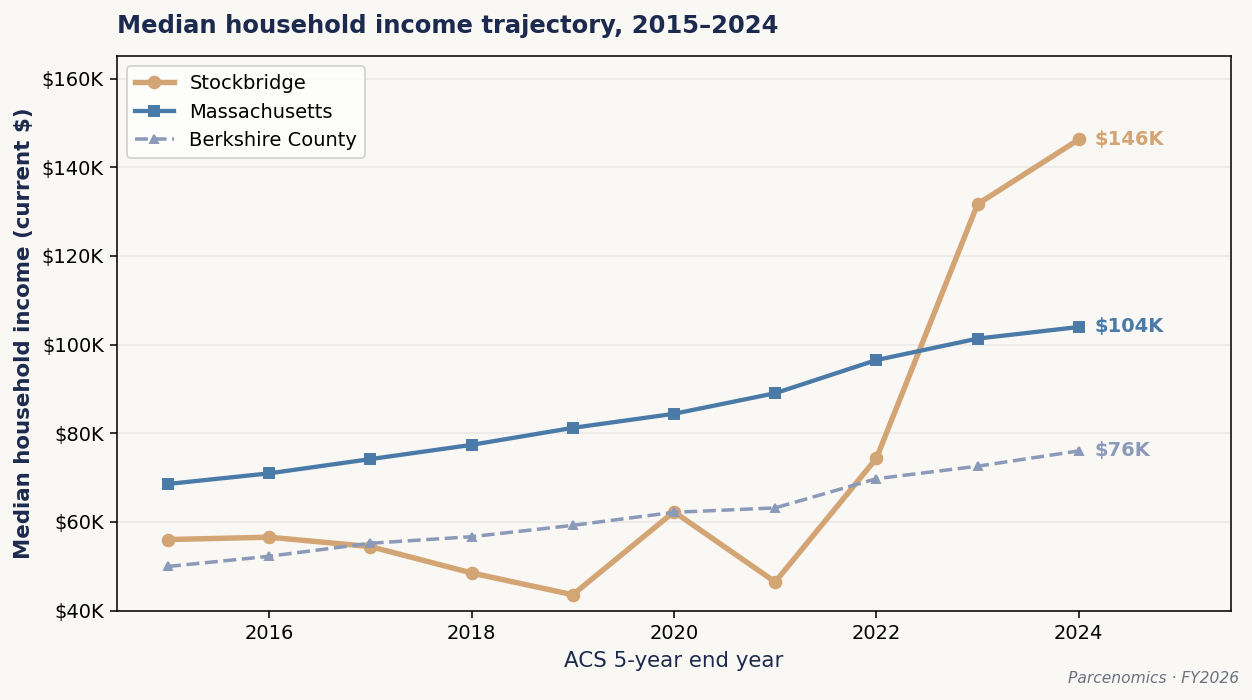
Income transformation. The middle-of-the-road Stockbridge family earned $56,027 in 2015 and $146,250 in 2024 — close to a doubling of purchasing power across nine years, as Chapter 1 documented. Across Massachusetts the typical family’s purchasing power grew about 15% over the same span. The Stockbridge figure reflects who lives in Stockbridge changing, not existing families earning more.
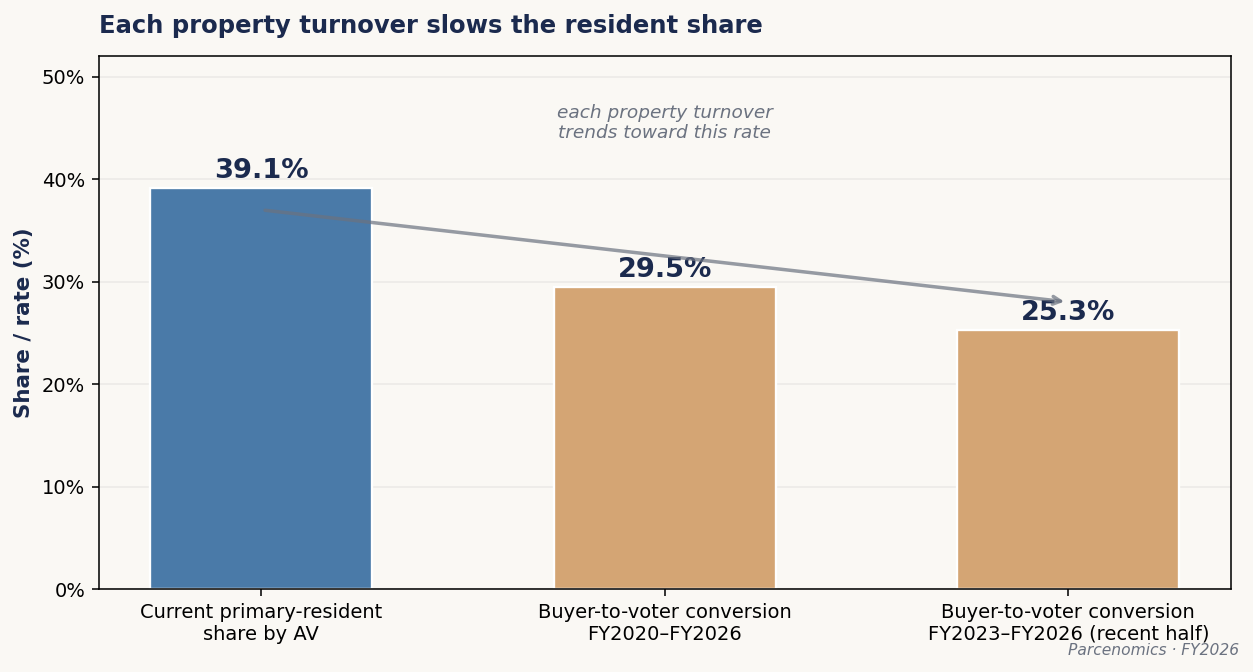
Buyer-to-voter conversion. Of residential property buyers in Stockbridge between FY2020 and FY2026, 29.5% became year-round Stockbridge voters at the purchased property’s address. In the most recent four fiscal years, the rate is 25.3%, against a current primary-resident share by assessed value of 39.1%. The recent-half figure being lower than the all-period figure means the conversion rate has declined within the window. Recent buyers are converting to year-round residents at a lower rate than buyers earlier in the window did.3
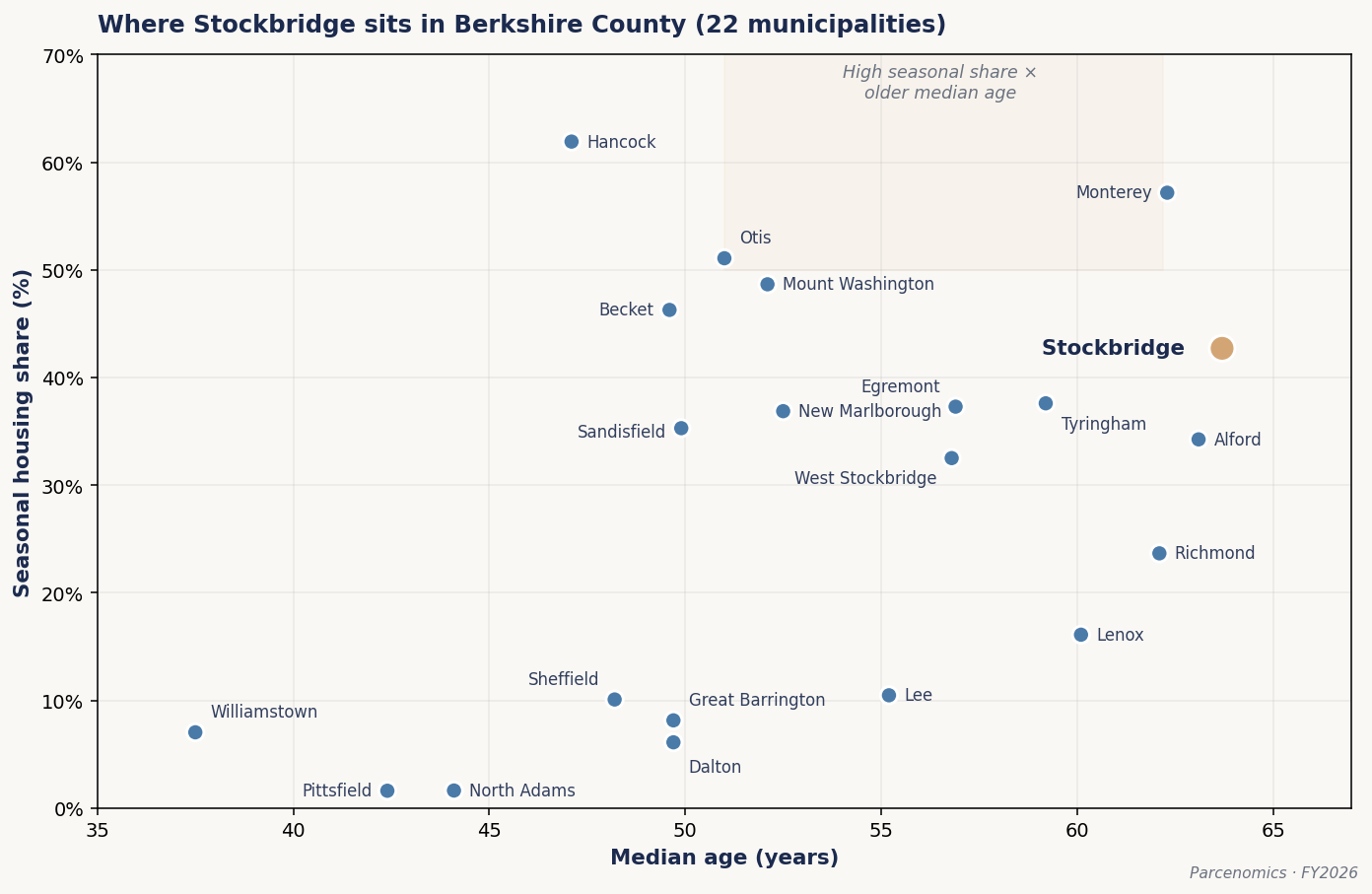
Peer positioning. Five Berkshire towns sit further along on the seasonal-share axis than Stockbridge does. Of the 22 Berkshire County municipalities plotted on a combined age-and-seasonal-share map — those for which ACS estimates at the necessary table level are available, out of the county’s 32 municipalities total — Stockbridge clusters with the older, more seasonal towns rather than with the larger year-round towns like Pittsfield, Lee, or Great Barrington.
Each indicator measures something different. Age structure measures the year-round residential population. Seasonal housing share measures the housing stock. Income transformation measures composition turnover. Buyer-to-voter conversion measures the inflow at the household-formation edge. Peer positioning measures the regional company Stockbridge keeps. The five do not duplicate each other. That they all point the same direction is the pattern.
What “further along” looks like
The five Berkshire towns ahead of Stockbridge on the seasonal-share axis are the closest available reference points for what this pattern looks like at a further stage of compounding. Hancock leads at 61.9% seasonal share, followed by Monterey at 57.2%, Otis at 51.1%, Mount Washington at 48.7%, and Becket at 46.3%. The seasonal-share axis isolates one variable. The five towns ahead of Stockbridge differ from it in scale, geography, and institutional density. They are not Stockbridge’s future. They are the closest available reference points for what the structural condition this chapter has described looks like at a further stage of compounding.
Downstream effects on the year-round community
The structural condition compounds across five domains. Each follows from the indicators above. None of them depends on additional measurement.
Civic capacity. Stockbridge runs on volunteer labor — fire and rescue, library, conservation commission, finance committee, planning board, and the dozens of smaller volunteer roles a small-town government depends on. Volunteer capacity depends not only on engagement but on physical capability and time. Fire and rescue work especially is physical. A 70-year-old retired professional may be highly engaged in town affairs and still unable to staff a 2 a.m. ambulance call. As the median age of the year-round population rises, the volunteer base contracts regardless of how engaged the year-round community remains.
School cohorts. Stockbridge’s net year-round household change over seven years was negative 10 (Chapter 1). The school-age cohort moves with the year-round household count, lagged by the age of children. Chapter 3 documented how the FY2024 EQV — measuring Stockbridge’s wealth from a market cycle ago — was the basis on which Stockbridge’s share of the BHRSD capital obligation was locked for thirty years. A school capital obligation calibrated to one measure of town wealth and paid out over thirty years against a school-age cohort that moves with the year-round household count produces rising per-pupil capital costs if the cohort shrinks. Chapter 1’s negative-10 net household change implies it will.
Workforce inaccessibility. The cultural and institutional anchors that draw second-home owners to Stockbridge — the survey cited in Chapter 2 found 60% of respondents called them the leading factor in their purchase decision4 — depend on a service workforce that increasingly commutes from Pittsfield, Lee, and Adams. Restaurant staff, hotel housekeeping, retail workers, and the seasonal workforce that supports Tanglewood-driven summer commerce are largely priced out of Stockbridge’s residential market. The amenity economy that defines Stockbridge’s identity is staffed by workers who can no longer afford to live in the town whose identity they sustain.
Seasonal commerce. Year-round businesses calibrate to summer demand. Restaurant capacity sized for July does not support year-round employment at scale. Retail hours contract in winter. Service businesses with year-round clientele compete for storefront space with seasonal operations that capture the bulk of their revenue in a 12-week window. Main Street’s commercial rhythm follows the tourist calendar rather than the residential one.
Tax base concentration. Chapter 3 documented that residential property is 91.1% of Stockbridge’s taxable base, with commercial new growth essentially zero for five of seven post-pandemic years. Every fiscal pressure — schools, roads, public safety, capital obligations — routes back through residential property tax. No other class has the scale to absorb meaningful additional revenue need. The tax base concentration is the fiscal face of the structural condition this chapter has described.
The political surfacing. The structural condition is no longer only visible in the data. On May 12, 2026, Great Barrington voters rejected a $2 million Proposition 2½ override 631 to 397 — a roughly 61% no vote. The override would have funded an operating-budget gap; rejection produced a drawdown of free cash reserves to approximately $454,000, below state guidelines for a financially healthy community. At the same town meeting and election, Great Barrington voters also *accepted* the Seasonal Community designation EOHLC had offered in December 2025 and *rejected* a citizen petition that would have directed the Select Board to adopt the §5C residential tax exemption.5 The combination is informative for Stockbridge: a Berkshire town in the second-wave designation cohort affirmed the designation, declined the operating-budget override, and declined the §5C exemption — three companion decisions on the same evening on three of the same tools Stockbridge is weighing. The terminology of legacy homeowners — property-rich, cash-poor full-time residents disproportionately burdened by tax increases — is increasingly used in Berkshire municipal discussions to describe the population most exposed to the structural condition this chapter has described. The political response and the analytical condition are now converging.
What the designation permits
The Seasonal Community designation Stockbridge received in December 2024 is not just a label. It expands one specific policy tool. The residential tax exemption under M.G.L. c.59 §5C is normally capped at 35% of the average residential assessed value. The 2024 Affordable Homes Act raised that ceiling to 50% for designated Seasonal Communities.6 Stockbridge is currently studying acceptance of the designation with the Berkshire Regional Planning Commission; acceptance has not been brought to Town Meeting as of the date of this profile. The mechanics, the trade-offs, and the Stockbridge-specific numbers under both the standard 35% ceiling and the expanded 50% ceiling are taken up in Chapter 5.
Two of the highest-profile projects in Stockbridge’s development pipeline would, if either reaches construction, represent the first significant commercial new growth in roughly a decade. The Desisto property — a former school campus — has been the subject of a multi-year mixed-use redevelopment proposal. Elm Court — a historic estate on the Stockbridge/Lenox border — has carried hospitality and resort-conversion proposals for over a decade. Neither has reached construction. Whether either does, in what form, and on what timeline are open questions that will materially affect Stockbridge’s commercial new-growth picture over the next decade.
The other levers Chapter 5 takes up — compliance recovery across personal property tax, vehicle and boat excise, short-term-rental community-impact fees, and the unused Proposition 2½ levy capacity — are not contingent on the Seasonal Community designation. They are tools the Town of Stockbridge has had available throughout. The designation expands the residential exemption ceiling specifically. The compliance and capacity levers stand on their own statutory authority.
The structural condition this chapter has described is the context in which those tools become consequential. They are not theoretical fiscal options. They are the operational levers a town in Stockbridge’s position has to consider.
Footnotes
- Seasonal Community designation: Massachusetts Affordable Homes Act of 2024 (Chapter 150 of the Acts of 2024, codified at M.G.L. c.23B §32). The Act provided for automatic designation of municipalities meeting statutory thresholds — in Berkshire County, a seasonal-housing share above 40% as measured by ACS B25004. EOHLC published the original designation list in December 2024. In December 2025, EOHLC extended designation offers to additional municipalities through a formula-based review weighing short-term rental concentration and second/vacation-home share. Statewide total designated as of early 2026: 44 communities (25 statutory, 19 by formula — 18 in the December 2025 announcement plus Rockport shortly thereafter). 18 of Berkshire County’s 32 municipalities (2 cities + 30 towns) are designated or eligible. The designation tools become operable in a town only after Town Meeting accepts the designation; acceptance status varies. ↩
- Five-indicator data sources. Median age and seasonal housing share for Stockbridge and the 22 Berkshire County peer municipalities (the subset of Berkshire County’s 32 municipalities for which ACS estimates at the necessary table level are available): ACS 2020-2024 5-year estimates, tables B01002 (median age) and B25004 (vacancy reason). Active voter file age distribution: Stockbridge town voter file, April 21, 2026 snapshot, active registrations with a known birth year. Median household income comparison figures cited in Chapter 1 Notes 1 and 2; reused here without re-derivation. ↩
- Buyer-to-voter conversion methodology — see Chapter 1 Note 4 for full methodology. Figures used in this chapter are the same situs-match measure with entity inclusion, applied to FY2020-FY2026 residential property sales. The all-period rate (29.5%) covers the full seven-year window; the recent-half rate (25.3%) covers FY2023-FY2026. The current primary-resident share of residential property by assessed value (39.1%) is the Chapter 2 residency tier classifier figure with manual overrides applied; see Chapter 2 Note 12. ↩
- Source: Berkshire Regional Planning Commission, Survey of Second Homeowners — Results (August 2022). The survey was sent to all second-home owners in Berkshire County, with 731 respondents from across the county’s 30 towns (Berkshire County contains 32 municipalities — 2 cities and 30 towns). Stockbridge was one of the top five participating towns with 61 respondents (8.3% of the sample). The full report is available at berkshireplanning.org. ↩
- Great Barrington override: The Berkshire Eagle, “Great Barrington voters overwhelmingly reject Proposition 2 1/2 override,” May 13, 2026. The override would have funded an operating-budget gap; rejection produced a drawdown of free cash reserves to approximately $454,000, below state guidelines for a financially healthy community. Berkshire County voters have historically declined Proposition 2½ overrides as a pattern; the May 2026 GB vote continued that pattern. ↩
- Residential tax exemption ceiling under M.G.L. c.59 §5C is normally capped at 35% of the average residential assessed value. Section 32(f) of Chapter 150 of the Acts of 2024 provides that a designated Seasonal Community may increase the §5C ceiling to 50% of the average residential assessed value, at the option of the board of selectmen in a town (or the mayor with the approval of the city council in a city). Under Section 32(f), the exemption applies only to the principal residence of the taxpayer as used by the taxpayer for income tax purposes — narrower than residency-classified property generally. The exemption is reset annually. The expanded 50% ceiling additionally requires the Town first accept the Seasonal Community designation under Section 32(b) by Town Meeting vote. Acceptance of the designation (Section 32(b), Town Meeting) and adoption of the exemption (Section 32(f), Select Board) are sequential and independent decisions. Stockbridge is currently studying acceptance of the Seasonal Community designation under Section 32(b) with the Berkshire Regional Planning Commission and has not voted on acceptance as of the date of this profile. Stockbridge has not adopted the residential exemption at any rate as of FY2026 — acceptance of the designation is the prerequisite for adopting the expanded 50% ceiling; the standard 35% ceiling under §5C is available without designation acceptance. Chapter 5 takes up the mechanics, scenarios, and Stockbridge-specific revenue and rate effects under both the standard 35% ceiling and the Seasonal-Community 50% ceiling. ↩