Chapter 2 · The Levers
1 · New growth — Seasonal Communities zoning and ADUs
Grow lever · who acts: Planning Board drafts the enabling bylaws, Town Meeting adopts, the Assessor books the growth
New Growth — What it is
Under Proposition 2½, newly built and assessed property is added permanently to the levy limit — capacity the Town may levy without an override, on top of the annual 2.5% and any override. New growth is the only true grow-the-base revenue lever: it adds capacity rather than recovering an existing obligation or shifting burden within the base. The enabling mechanism is zoning — the housing provisions of the Seasonal Communities designation, and, separately, an accessory-dwelling-unit (ADU) bylaw.
The capacity is potential, not bankable. It exists only once units are actually built and assessed, which takes years; and new units also draw municipal services, so the figures below are gross levy capacity, not net fiscal gain.
New Growth — What the lever does, quantified
New growth added to the levy limit equals new taxable assessed value times the tax rate ($13.24 / $1,000) — so the figure turns on the assessed value of each new home, which is not yet known. This report models a blended value of about $700,000 per new home as the central case, and brackets it with a lower and a higher value so policymakers can see the sensitivity.
New-growth basis (Parcenomics modeling assumptions). New-growth revenue is (new homes) × (assessed value per home) × the tax rate; both inputs are modeled, not yet realized.
- Where the parcels come from. The additional buildable parcels are grounded in the housing reforms tied to Great Barrington’s Seasonal Communities designation — not speculative development. The designation requires the Town to adopt bylaws permitting undersized lots to be used for year-round housing and to allow tiny houses (M.G.L. c.23B §32, the Seasonal Communities statute in the 2024 Affordable Homes Act), and a separate accessory-dwelling-unit (ADU) bylaw adds units on existing lots. (The state mandate is to permit those undersized-lot and tiny-house uses; the specific lot-size and dimensional thresholds are set by local bylaw, so the number of parcels this unlocks is a Town-level design choice — the 25–100-home band below is a modeled pace, not a parcel-by-parcel count.)
- What each new home is worth. A blended ~$700,000: one-third (33%) deed-restricted affordable at ~$500,000 (the deed restriction caps assessed and resale value) and two-thirds (67%) at market, ~$800,000 — the market figure anchored to recent Great Barrington sales (2022–2026: mean ~$699,000, 75th percentile ~$795,000). The 33/67 split and the $500,000 deed-restricted value are stated modeling assumptions, not a town-adopted requirement; the $800,000 market leg is anchored to the sales record.
New growth remains potential, not bankable until units are built and assessed.
At the modeled $700,000 blended value, the permanent annual levy capacity is:
| Avg new-home value (basis) | 25 homes (5-yr) |
50 homes (mid) |
100 homes\ |
|---|---|---|---|
| $500K (all-affordable case — recent-sales median) | $165,500 | $331,000 | $662,000 |
| $700K (blended modeling basis — see assumption) | $231,700 | $463,400 | $926,800 |
| $800K (all-market case — recent-sales p75) | $264,800 | $529,600 | $1,059,200 |
Read: at the modeled ~$700,000 blended value, 50 new homes add about $463,400 a year of permanent levy capacity once built and assessed — about 40% above the ~$331,000 the earlier flat-$500K figure implied. The value-per-home is a labeled modeling assumption, bracketed by the $500K (all-affordable) and $800K (all-market) sensitivity rows; the capacity is recurring and compounds into the levy base as units come online (100 homes over five years ≈ 20/year, building to the steady-state figure).
ADUs run on the same mechanic under a separate bylaw, but an accessory unit adds less assessed value than a standalone home — so value each at a realistic $250,000:
| ADUs (5-yr) | New taxable AV @ $250K each |
Permanent annual levy capacity |
|---|---|---|
| 25 | $6,250,000 | $82,750 / yr |
| 50 | $12,500,000 | $165,500 / yr |
| 100 | $25,000,000 | $331,000 / yr |
The unit counts and average values are labeled scenario assumptions, not data; the rate is verified. Quantify this lever as a range tied to visible assumptions — never a point estimate.
New Growth — The ownable workstream
| Who acts | The Planning Board drafts the Seasonal Communities housing provisions and the ADU bylaw; Town Meeting adopts; the Assessor books new growth as units are built and assessed. |
| The owner’s bucket | Maintain the new-growth capacity model — track permitted and assessed units against the scenario band so the owner watches capacity convert from potential to bankable. |
| Sequence | Bylaw adoption (a Town Meeting calendar item) → multi-year build-out → capacity accretes. This is the longest-horizon grow lever. |
2 · Simon’s Rock reactivation
Grow lever · who acts: the Assessor determines taxable status on the qualifying use; the Selectboard is informed
Simon’s Rock — What it is
Bard College at Simon’s Rock holds substantial real property currently exempt from taxation as charitable and educational property under M.G.L. c.59 §5, Clauses 3 (the “3ABC” exemptions). An exemption of this kind rests on the parcel’s qualifying use. Where an institution reduces or ceases the educational use that grounds the exemption, the basis for it can lapse and the parcel returns to the taxable roll. Given Simon’s Rock’s operational changes, the question the Assessor can examine — parcel by parcel — is which holdings still qualify and which have moved to a taxable posture. This belongs in the grow-the-base family: it adds taxable value the Town does not currently levy on.
Simon’s Rock — What the lever does, quantified
The aggregate assessed value of the 3ABC-exempt holdings is $58,956,100; at the FY26 rate that is ~$781,000/yr of reactivated levy. A narrower reading of the affected value (per the Assistant Town Manager, ~$44M) yields ~$583,000/yr. The two AV figures are unreconciled, so the lever carries as a range — $583K to $781K per year — effective FY2028 at the earliest, and reconciling that gap to a single defensible figure is the first analytical task before it enters any budget projection.
Like new growth, this is potential, not bankable: it depends on the Assessor’s taxable-status determination and is contestable by the institution through abatement. A smaller parallel question exists for the former Searles high-school property — a companion exempt-to-taxable item, not a separately sized lever here.
Simon’s Rock — The ownable workstream
| Who acts | The Assessor determines taxable status on the qualifying use, parcel by parcel; the Selectboard is informed; any change is appealable by the institution. |
| The owner’s bucket | Commission the exemption-status brief — which parcels, which use, which assessed value — and reconcile the $44M-vs-$58.96M AV gap to one figure before it is projected. |
| Sequence | Exemption-status brief → AV reconciliation → Assessor determination → FY28 earliest booking. |
3 · Personal-property non-filer recovery and under-declaration
Recover lever · who acts: the Assessor, through a compliance letter
Personal Property Tax — What it is
Second homes and non-resident-owned residential property owe an annual personal-property tax on their furnishings and contents (Class 501), declared each year on a form of list. Many such owners file nothing, and many file a value far below their home’s plausible contents. This lever recovers tax already owed under current law — it is not a new tax and not a rate change.
The mechanism is a non-accusatory compliance letter. The Assessor issues a letter that states the statutory itemization and true-list obligation, mail-merges each recipient’s own currently-declared amount, and asks the owner to confirm the declaration is complete. No accusation, no inspection, no appraisal — a share of recipients self-correct on receipt, at near-zero administrative cost. The posture throughout is candidate re-canvass, never a fraud allegation; everything below is stated in the aggregate, with no parcel named.
Personal Property Tax — The opportunity, at a glance
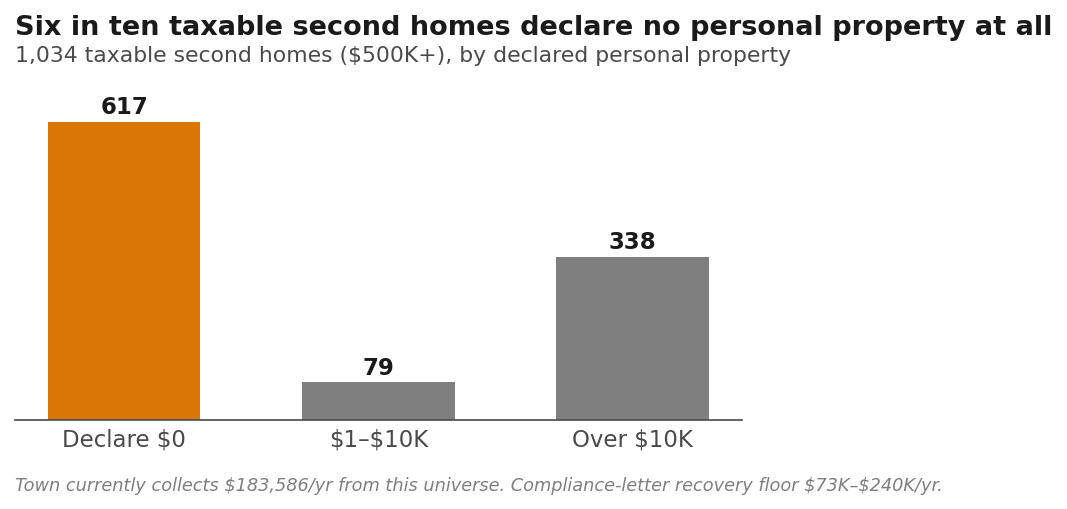
The sharpest, assumption-free view of the opportunity is simply how the taxable second-home universe distributes by what it currently declares. A furnished second home cannot credibly hold under $10,000 of fair-market contents, so the “declares nothing” and under-$10K bands are the opportunity, with no estimate attached.
| Declared personal property | Parcels | Share | Aggregate declared | PP tax now | Potential Impact |
|---|---|---|---|---|---|
| none / no account | 617 | 60% | $0 | $0 | $73K–$240K floor |
| $1–$10K | 79 | 8% | $516,680 | $6,841 | |
| $10K–$25K | 206 | 20% | $3,415,070 | $45,216 | |
| $25K–$50K | 62 | 6% | $2,057,200 | $27,237 | |
| $50K–$100K | 44 | 4% | $3,221,980 | $42,659 | |
| over $100K | 26 | 3% | $4,655,090 | $61,633 | |
| Total | 1,034 | 100% | $13,866,020 | $183,586 | $73K–$240K + $141K–$446K delta* |
* Potential Impact: the “declares nothing” band is the non-filer population the conservative floor ($73,288–$239,905/yr) quantifies; the under-declaration delta ($141,000–$446,000/yr, a labeled sensitivity) layers across the under-declared bands — shown separately, not summed, consistent with the section.
The shape is the argument. Of the 1,034 taxable second homes, 617 (60%) declare no personal property at all, and 696 (67%) declare under $10,000 — and a furnished high-value second home cannot credibly hold under $10,000 of fair-market contents. That bottom-of-the-table mass is the opportunity, with no estimate attached to it. The Town currently collects $183,586 a year in personal-property tax from the entire second-home universe; the compliance letter targets exactly the “declares nothing” and under-$10K bands.
Personal Property Tax — What the lever does, quantified
The floor (the on-page number). Recovery from non-filers, anchored conservatively to the filed Class-501 base (median declared $14,840), is $73,000–$240,000 per year. This is the verified, defensible figure — the one the compliance letter rests on, because the letter needs nothing beyond the statute and the recipient’s own declared amount.
The under-declaration delta (a labeled sensitivity, shown separately). Bringing each under-declared second home up to a band-keyed fair-market-value contents floor — net of what it already declares — adds an estimated $141,000–$446,000 a year (mid case ~$253,000), across a low/mid/high bracket on the contents assumptions. This captures the broad pattern, not a narrow art tail: every furnished high-value second home holds taxable contents above a $15K declaration, valued at fair market value (depreciated furnishings largely wash out; held-value items — art, antiques — do not). The delta is a labeled sensitivity, never the headline, and it does not reach the §5C scale because personal property is a ~1.3% tax.
Why the $500K-and-up scope. The recoverable universe is read across the second homes assessed at $500,000 and above, because that is where credible contents value concentrates and where the largest pool of under-declarers sits. A furnished $750,000 second home can hold a genuinely valuable collection, and the $500K–$1M band is the single largest group of second homes — confining the analysis to the trophy tier above $1M would zero out most of the opportunity. The contents floor is band-keyed so a modest second home contributes modestly and the high end carries the weight.
Durability. Recovered personal property is part depreciating (furnishings, eroding toward a floor) and part appreciating (art, antiques, which hold). Roughly 63%–80% of year-one recovery persists to year five — a one-time-plus-decaying annuity, not a permanent line.
Personal Property Tax — The ownable workstream
| Who acts | The Assessor issues the compliance letter and processes the self-corrections. |
| The owner’s bucket | Own the distribution exhibit and the letter template; carry the recoverable floor into the budget conversation as a recover line, with the delta as a labeled sensitivity behind it. |
| Sequence | Finalize the distribution → letter template → mail merge → self-correction window → re-canvass of non-responders. |
4 · Motor-vehicle excise
Recover lever · who acts: Assessor and Collector
Motor-Vehicle Excise — What it is
Motor-vehicle excise is billed on vehicles garaged in the Town. Gaps arise where a vehicle is garaged in Great Barrington but registered elsewhere, or where registrations lag actual garaging — a pattern that is more pronounced in towns with a high second-home presence. The recovery method (cross-referencing the registry against the resident and second-home universe) is the one developed for Stockbridge and is ported and ready to run for Great Barrington.
Motor-Vehicle Excise — What the lever does, quantified
An order-of-magnitude extrapolation (labeled estimate, pending the GB run). Massachusetts motor-vehicle excise is billed at $25 per $1,000 of a depreciated vehicle valuation — a typical bill runs ~$150–$350 a year. The recoverable gap is the set of vehicles garaged at a Great Barrington property but registered to an owner’s primary address elsewhere, so the excise is billed by another town or not at all. Sized off the second-home cohort: if even 10–25% of the ~1,034 non-resident/second-home properties keep one such vehicle garaged in town (≈100–260 vehicles) at an average ~$250 bill, the recoverable gap is on the order of $25,000–$65,000 a year. Every input here is a labeled assumption, not a measurement — a scenario to be replaced by the GB registry cross-reference (the same cross-silo method built for the Stockbridge engagement), not a bankable figure.
Motor-Vehicle Excise — The ownable workstream
| Who acts | The Assessor and Collector run the registry cross-reference and pursue the billing gap. |
| The owner’s bucket | Authorize the GB excise-gap run; bring the quantified gap back to policymakers as a recover line. |
| Sequence | GB run → gap quantified → recovery process. |
5 · Boat excise
Recover lever · who acts: Assessor and Collector
Boat Excise — What it is
The same mechanic as motor-vehicle excise, on a smaller base: boat excise is owed on vessels habitually moored or docked in the Town, and a gap arises where a vessel is moored locally but registered or declared elsewhere. The Stockbridge method is ported.
Boat Excise — What the lever does, quantified
An order-of-magnitude extrapolation (labeled estimate, pending the GB run). Boat excise is billed at a much lower rate ($10 per $1,000 of valuation) on a far smaller population of vessels moored or docked in town. On the same cohort logic, the recoverable gap is modest — on the order of $5,000–$15,000 a year — a labeled scenario, not a measurement. It is included for completeness and because it runs on the same data as the motor-vehicle cross-reference, at near-zero added effort.
Boat Excise — The ownable workstream
| Who acts | The Assessor and Collector. |
| The owner’s bucket | Fold the boat-excise run into the motor-vehicle excise workstream (same data, same owners). |
| Sequence | GB run (with #4) → gap quantified → recovery. |
6 · The residential exemption (§5C) and the striated study
Shift lever · revenue-neutral · who acts: Selectboard at the classification hearing, on the Assessor’s analysis
Residential Exemption — What it is
Today every home in Great Barrington is taxed at the same rate, whether it is someone’s year-round house or a second home used a few weekends a year. A residential exemption (M.G.L. c.59 §5C) changes that. It lets the Town take a fixed dollar amount off the taxable value of every home that is a primary residence — the house the owner actually lives in — so those owners are taxed on less of their home’s value. The Town does not collect any less money overall: the amount taken off the year-round homes is made up by the properties that do not qualify — second homes, seasonal homes, and homes held through LLCs or trusts. In short, it shifts part of the residential tax bill off the people who live here year-round and onto the people who don’t. Because the Town’s total collection does not change, this is a redistribution — not a new tax, and not a tax cut for the town as a whole. Some homeowners pay less, others pay more, and the total stays the same.
The exemption is set as a percentage of the average residential value, and Great Barrington chooses the level. At 20% that is a flat exemption of $113,892 per qualifying home; at the 35% statutory default, $199,310; and because Great Barrington is a designated Seasonal Community, it may go as high as 50%, a $284,729 exemption. Whichever level it picks, owner-occupants below a break-even home value pay less, and the difference is carried by residential property that does not house its owner — second homes, entity-held parcels, and the highest-value owner-occupied homes.
The finding that resizes it
Whether this lever is worth pulling turns entirely on one number: how much of Great Barrington’s residential property is not owner-occupied. The Town has historically described that share as 12–15%. It is not.
On positive evidence — out-of-state mailing, voter registration in a peer town, or a second-home personal-property account — Great Barrington’s non-owner-occupied residential share is at least 28% of the 3,470-parcel residential universe (978 parcels). The strongest, most unambiguous slice alone is 20.2%. A further ~5% of parcels sit in entities the public record cannot resolve to a person — overwhelmingly LLCs registered to agent or property-manager addresses rather than to an owner — so the true figure lies between 28% and ~34%.
Two points of method sit under that number:
- It is built from evidence, not residual. Every parcel in the 28% carries a positive non-resident signal — an out-of-area mailing, a peer-town voter registration, or a second-home personal-property account. The figure is not what is left over after subtracting known residents.
- Residents’ own trusts are counted as resident. Where a parcel is held in a trust or LLC whose responsible individual is a Great Barrington voter mailing in-town, it is treated as owner-occupied — so the share does not inflate itself by sweeping local estate-planning entities onto the non-resident side of the ledger.
Which level, and who comes out ahead
Whichever level Great Barrington picks, the mechanics are the same: below a tipping-point home value — the break-even — a year-round owner pays less than today, above it more. The striking thing is how steady the break-even stays across all three levels, sitting in the high-$800,000s (a bigger exemption comes with a correspondingly higher rate on the value that remains taxable):
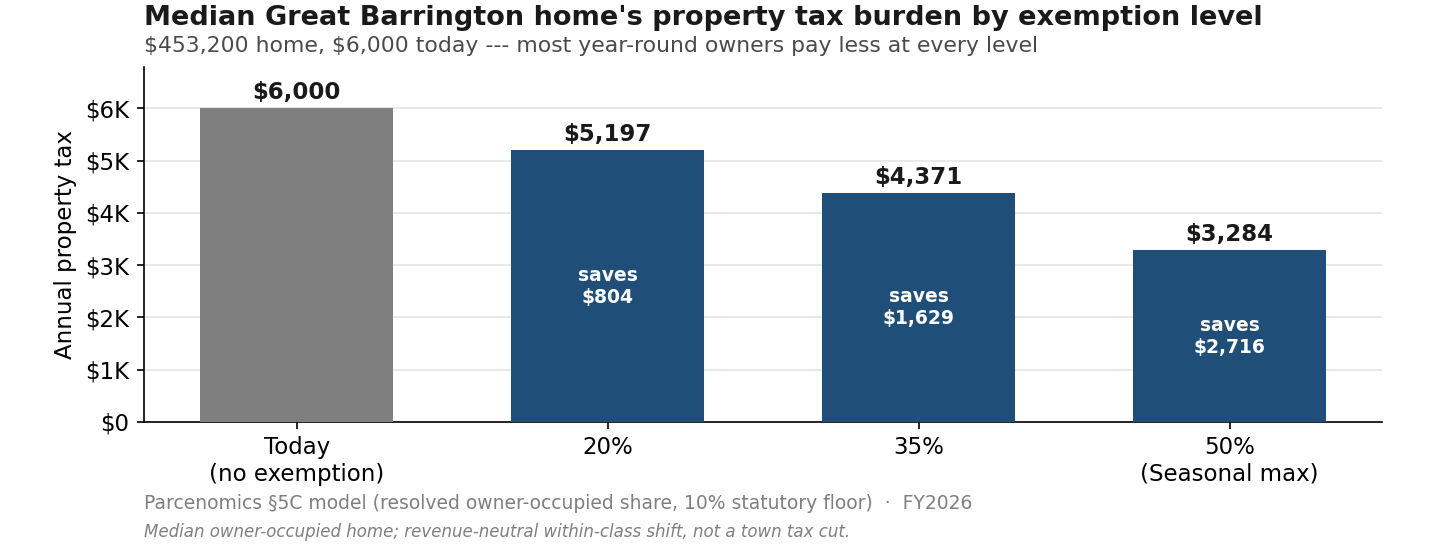
The median Great Barrington home’s property tax burden at each exemption level (median owner-occupied home, assessed $453,200, about $6,000 today)
| Exemption level | Break-even (homes below this come out ahead) | Property tax burden |
|---|---|---|
| 0% (today) | n/a | $6,000 |
| 20% | ~$840,000 | ~$5,197 |
| 35% | ~$863,000 | ~$4,371 |
| 50% (Seasonal Communities maximum) | ~$888,000 | ~$3,284 |
Two things a resident can take from that table. First, the Town’s earlier discussion put the break-even near $1,000,000, which made the exemption look like it mainly helps expensive homes — but the real break-even is lower and barely moves, so at every level the break reaches a wide range of ordinary homes: a home worth less than roughly $850,000 comes out ahead no matter which level Great Barrington chooses. Second, the level is really a dial on how much the winners save, not on who wins — the median year-round home saves about $800 at 20%, $1,629 at 35%, or $2,716 at 50%.
Because most owner-occupied homes in town fall below the break-even, most year-round homeowners come out ahead at any of the three levels — and where the added burden lands is the politically salient fact: about 80% of the increase at 20% (81% at 35%, 82% at 50%) falls on owners who are non-resident or entity-held — owners who do not vote in Great Barrington. Stated as analysis and not as advocacy: the residential exemption concentrates its cost on property outside the local electorate, and its benefit on resident owner-occupants below the break-even. And the total moved is largely insensitive to the exact owner-occupied share — shrinking the owner-occupied base both lowers the value given away and enlarges the base that pays for it, and the two effects roughly cancel — so the headline transfer does not balloon just because the non-resident share is higher than the Town assumed.
The one group to watch: house-rich but cash-poor
The homeowners who could feel a pinch are those whose homes sit just above the break-even but whose incomes don’t match their home’s value — often longtime residents, frequently retirees, whose house climbed in value over the years while their income did not. In Great Barrington that is roughly 180 owner-occupied homes valued between $800,000 and $1,000,000, and another 127 between $1,000,000 and $1,200,000 — the homes near and just above the break-even. (At the higher exemption levels the break-even rises a little, so a few of those homes flip to winners rather than payers.) The Town already has tools that soften this, usable alongside the exemption: a qualifying senior can defer the tax — put off paying it, repaid later when the home is sold (Clause 41A) — or work it off through a town program worth up to $1,500 a year (Clause 41K). So a cash-poor senior whose home sits above the break-even is not forced to absorb the higher bill out of pocket.
LLC-held homes: statewide law, with an easy cure
One eligibility rule deserves to be stated precisely, because it is easy to misread as a flaw in the lever — or to deploy as one. A home whose title is held by an LLC or other business entity does not qualify for the exemption, even if the people living there are full-time Great Barrington residents. This is not a Great Barrington choice or an anti-exemption gloss; it is the uniform statewide rule. Section 5C grants the exemption only for “the principal residence of a taxpayer as used by the taxpayer for income tax purposes,” which the Department of Revenue and assessors administer as a record-ownership test: the applicant must be an owner of the home on the assessment date. An LLC is a separate legal person with no principal residence — and §5C goes out of its way to deem cooperative-corporation members owners so they can qualify, while writing no equivalent rule for LLCs. The established exemption towns — Boston, Brookline, Watertown and Eastham among them — apply it identically.
Two things keep this from being either a loophole or a trap:
- Trusts qualify. A home held in trust is eligible as long as the resident is a trustee with a beneficial interest — the ordinary estate-planning arrangement. The exclusion is specific to business entities, not to everyone who declines to hold title in their own name.
- The cure is trivial. An owner-occupant who holds their home in an LLC and wants the exemption simply re-titles it into their own name or a qualifying trust — a one-time deed change. No genuine resident is permanently shut out; each decides whether the exemption is worth the re-titling.
For this report’s arithmetic the rule cuts one way only — toward conservatism. Chapter 6 counts an LLC-held parcel whose responsible individual is a local voter as owner-occupied, on the resident side of the ledger; under the statute those parcels cannot actually claim the exemption, so they are bearers, not beneficiaries. The true non-qualifying base is therefore at least as large as the 28–34% stated here.
What it does for an individual resident
The break-even — the owner-occupied home value at which the exemption saving exactly offsets the higher rate — is:
- 20% exemption → break-even ≈ $840,291 (residential rate rises from $13.24 to $15.32)
- 35% exemption → break-even ≈ $863,058 (residential rate rises to $17.22)
- 50% exemption → break-even ≈ $887,573 (residential rate rises to $19.49)
A Great Barrington owner-occupied home assessed below ~$863,058 sees a tax cut; above it, an increase. The residential median home is $453,200 — well below break-even — so the typical resident owner-occupant is a beneficiary. At 35% (with the §5C 10% taxable-value floor applied):
| Owner-occupied home (assessed) | Tax today (uniform $13.24) | Tax with §5C at 35% | Net change |
|---|---|---|---|
| $200,000 (low-end) | $2,648 | $344 | ↓ $2,304 |
| $453,200 (residential median) | $6,000 | $4,371 | ↓ $1,629 |
| $733,598 (just under break-even) | $9,713 | $9,198 | ↓ $515 |
| $863,058 (break-even) | $11,427 | $11,427 | $0 |
| $1,294,586 (above break-even) | $17,140 | $18,856 | ↑ $1,716 |
Note — §5C 10% floor. By statute (c.59 §5C), the exemption cannot reduce a parcel’s taxable value below 10% of its full and fair cash value. That floor binds for owner-occupied homes below ~$221,000: a $200,000 home is taxed on $20,000 (a $344 bill), not on the $690 a flat $199,310 exemption would otherwise leave. The figures above apply that floor.
At 50%, the cut deepens for the typical resident (the median home saves $2,716) and the break-even moves slightly, to ~$887,573; the cost rises correspondingly on property above it.
That small drift is the only way the exemption’s size touches the break-even. The break-even is otherwise structural — it is set by the share of homes that take the exemption, not by how large the exemption is; in the algebra the exemption cancels out. What nudges it up at the higher levels is the 10% floor: at a larger exemption, more low-value homes rest at the floor and so absorb less of the shift. Absent the floor, the break-even would be identical at every level.
One thing it does not do. The residential exemption raises no new money for the town’s budget gap. It only moves money around within the residential class — from second homes toward year-round homes, about $1.6M at 20%, $3.0M at 35%, and up to $4.7M at 50%. It is a fairness tool, not a revenue tool, and it should never be counted toward closing the operating shortfall.
The striated study is the companion
The exemption answers who pays among residential owners. The striated price survey (an IAAO-standard ratio study, by value band) answers a prior question the exemption rests on: whether the assessment roll itself is even-handed across the value distribution, or whether high-value property is systematically under-assessed relative to modest property. Where regressivity is present, it compounds the case the exemption addresses — and where it is absent, it bounds the exemption’s reach. The two travel together; the study is the evidentiary floor under the burden-shift levers (this lever and #7).
Does the exemption cool the second-home market?
A second objection runs the other way: that a residential exemption cools the second-home market — deterring buyers and eroding the tax base. Three responses hold it in check. First, the increment is small relative to price: the additional annual bill on a non-owner-occupied home is a modest figure against a purchase in the seven figures, and second-home demand in the Berkshires is driven by amenity — location, landscape, cultural access — far more than by the marginal property-tax line, which makes that demand relatively tax-inelastic. Second, comparable tax gaps have not cooled the market: Great Barrington already carries a higher residential rate than some neighboring towns without losing its second-home appeal, so a within-class shift of this size is unlikely to be the deciding factor for a buyer choosing the town for its amenities. Third, the exemption does not raise the town’s total residential take — it redistributes within the class — so there is no aggregate new burden on the market, only a reweighting toward owner-occupants. (Any external empirical claim — property-tax capitalization magnitudes — should be sourced before this passage publishes; the argument here stands on the internal comparison and the revenue-neutral structure.)
Does the exemption raise rents?
The most common objection is that the exemption raises taxes on rental property and landlords pass that through as higher rent. It is not baseless — where the stock is market-rate rental, some pass-through is real (Massachusetts analyses model it as partial, and larger in tight markets). But in Great Barrington the claim is overstated, and where it has force there is a clean design fix.
Start with how rent is set: rent is what a tenant can and will pay, not a sum of the landlord’s costs. Recent history is the proof — area rents rose far faster than any landlord cost, because pandemic-era demand let owners charge what the market would bear while taxes, maintenance and insurance did not double. And the tenant’s ceiling is already pressing hard: about half of Massachusetts renters spend more than 30% of income on housing, a quarter more than half — little slack left to absorb a new charge. When rent already sits at the market ceiling, a tax increase is absorbed in the owner’s margin or capitalized into a lower sale price, not added to rent. The increment is small in any case — the higher rate is about $4 more per $1,000 of value, roughly $1,600 a year on a $400,000 unit, against demand-driven rent moves many times larger.
First, the total residential levy does not change. The exemption redistributes the existing residential tax; it adds no aggregate cost to the housing sector. It moves burden from owner-occupants below the break-even toward non-owner-occupied and high-value property.
Second, the property that bears the exemption is overwhelmingly second homes, not year-round rentals. The non-owner-occupied share the exemption targets (Chapter 6’s 28%-plus) is dominated, in a seasonal Berkshire town, by seasonal and second-home property. The slice that is actually year-round market-rate rental — the only stock from which a Great Barrington tenant’s rent could rise — is a minority of the affected base. The lever lands on absentee and high-value owners; that is the point of it.
Third, regulated and nonprofit-owned rentals cannot pass a tax change through to rent. Where rent is set by public-housing rules, deed restriction, or subsidy rather than the market — which describes most of Great Barrington’s affordable stock (the 368 inventoried affordable units, largely housing-authority, nonprofit, and tax-credit owned) — there is no market rent for a tax change to flow into, and much of that stock is tax-exempt to begin with. The renters most often invoked in the objection are the renters least exposed to it.
Fourth, where the concern does have force — the genuine year-round, market-rate rental — the exemption can be designed to protect it. Massachusetts communities (Provincetown is the worked example) have adopted a variant that extends the exemption to property with full-time renters, so long-term rental housing is treated like owner-occupied housing rather than like a second home. That variant also tilts the owner’s incentive away from short-term-rental platforms toward full-time tenants — returning units to the long-term market, which works in the opposite direction of the rent-increase concern.
In short: the exemption’s incidence falls overwhelmingly on second homes and absentee owners, not year-round rentals, and where the renter concern is real the full-time-renter variant addresses it. It is a question of exemption design, not a reason the lever raises rents across the board. (Incidence framing and the full-time-renter variant: Massachusetts Budget and Policy Center, “MA Property Taxes: Who Pays?”; to be archived before publication.)
Why, then, has no Berkshire town adopted it?
If the exemption helps most year-round owners, why has no municipality in Berkshire County adopted it? Because its cost is concentrated on an organized, well-resourced minority — non-resident and high-value owners — while its benefit is spread thin across an unorganized majority. That is the shape of a policy popular in the aggregate that dies at Town Meeting.
Residential Exemption — The ownable workstream
| Who acts | The Selectboard adopts (or declines) the residential exemption percentage at the annual tax classification hearing, on the Assessor’s analysis. Town Meeting is not the adopter. |
| The owner’s bucket | Commission and own the striated study; carry the break-even model at Great Barrington’s resolved owner-occupied share into the classification-hearing record so the Selectboard decides on quantified ground rather than on the 12–15% assumption. |
| Sequence | Striated study → break-even model at resolved share → classification-hearing brief. The study can begin immediately; the adoption decision is a fall calendar item. |
7 · Within-class regressivity correction
Shift lever · revenue-neutral · who acts: the Assessor, through reassessment discipline
Within-Class Regressivity — What it is
When an assessor values thousands of homes by formula, the result is rarely perfectly even across the price range. In many Massachusetts towns the most expensive homes come in a little under their true market value while ordinary homes land right on it — so the ordinary home quietly pays a bit more than its share and the high-end home a bit less. Correcting it — holding every price band to the same standard — shifts a little of the load back up the value scale. It raises no new money; it evens out who pays, which is why it sits in the same family as the residential exemption and rests on the same kind of sale-versus-assessment study.
Within-Class Regressivity — What the lever does, quantified
We ran the study. Across 1,088 arm’s-length residential sales (FY22–FY26), Great Barrington’s assessment-to-sale-price ratios fail the international uniformity standard: the Price-Related Differential (PRD) — the standard IAAO test for regressivity — is 1.164, outside the acceptable band of 0.98–1.03. By that professional measure the roll is regressive: modest homes are assessed at a higher fraction of market value than expensive ones.
But the magnitude is mild, and it is concentrated at the bottom of the market. Median assessment ratio by price quintile:
| Price quintile | Median assessment-to-sale ratio |
|---|---|
| Q1 (lowest-price) | 0.96 |
| Q2 | 0.94 |
| Q3 | 0.94 |
| Q4 | 0.93 |
| Q5 (highest-price) | 0.94 |
The tilt is essentially the lowest-price tier carrying a ~2-point-higher ratio than everything above it; the rest of the distribution, high-value homes included, is uniform at about 0.94. That is a real but narrow regressivity — it touches the cheapest homes, not a broad high-end giveaway. (For contrast, Stockbridge’s striated study returned a PRD of 1.34 with its highest-value tier assessed at about 0.74 of market — a far steeper tilt. By this measure Great Barrington’s assessor is comparatively even-handed.)
What it’s worth, per home (illustrative). Bringing the lowest tier into line with the rest is roughly a 2% assessment correction on those homes — about $80 a year on a $300,000 home. At the residential median ($453,200) and above, the ratio already sits at the town norm, so the effect is near zero. Extended across the lowest fifth of the residential class (on the order of ~680 homes), the total mis-allocation is on the order of $50,000–$70,000 a year — real, worth correcting on fairness grounds, but an order of magnitude smaller than the residential-exemption or apportionment levers. (Per-home and total figures are illustrative, derived from the quintile tilt at the $13.24 rate; the precise correction is set at the reassessment, not by this study.)
This is the one lever where the finding cuts partly for the Town: the roll is mildly regressive by the international standard, but far less so than a peer like Stockbridge, and the median homeowner is assessed right at the town norm. Stating that plainly is worth more than overstating it — and it is the section that makes the rest of the report credible. The larger assessment-equity question in Great Barrington is not price regressivity within the owner-occupied class; it is who sits outside it and therefore bears the residential exemption (§6).
Within-Class Regressivity — The ownable workstream
| Who acts | The Assessor, through reassessment discipline at the lowest-price tier — and, if a sharper test is wanted, a multi-year re-cut of the sales study. |
| The owner’s bucket | The ratio study is essentially done (PRD 1.164, 1,088 sales). The optional next step is the multi-year, class-stratified re-cut (the method used in Stockbridge), which tests whether the same-year ratio understates the tilt. |
| Sequence | Ratio study (done) → optional multi-year re-cut → reassessment cycle. |
8 · Split rate
Shift lever · revenue-neutral · who acts: the Selectboard at the classification hearing
Split Rate — What it is
Massachusetts lets a town put a higher tax rate on business property — stores, offices, industrial sites — than on homes, taking some of the load off homeowners. The Selectboard decides it at the same fall hearing as the residential exemption.
Split Rate — What the lever does
How much relief it can deliver depends on how much business property the town has to lean on — and Great Barrington doesn’t have much. Business and industrial property together are only about 13% of the town’s taxable value, and the homeowner share keeps climbing (about 84% in FY26). With so small a business base, even the largest shift the law allows moves only a modest amount off homeowners — and it lands on a business sector that is already under pressure. The exact dollars at each rate await the GB run, but the ceiling is low because the base is small.
Split Rate — The ownable workstream
| Who acts | The Selectboard at the fall classification hearing, on the Assessor’s business-property analysis. |
| The owner’s bucket | Commission the split-rate numbers; brief them into the same hearing record as §6. |
| Sequence | GB run → the numbers → classification-hearing brief (same hearing as §6). |
9 · Senior and legacy exemptions
Shift lever · revenue-neutral · who acts: Town Meeting accepts the local option; the Assessor administers
Senior Exemptions — What it is
Massachusetts offers a suite of local-option exemptions targeting seniors and long-tenured owners — among them Clause 41A (senior tax deferral), the Clause 41C/41D senior exemption, and the Clause 17-series options — that provide targeted relief without a general rate change. Several are adopted by local option: Town Meeting accepts the statute, and the Selectboard and Assessor administer it. They are shift levers — relief to a defined group, carried by the rest of the class.
Senior Exemptions — What the lever does, quantified
Great Barrington has already adopted most of this suite — several clauses above the statutory floor. The Board of Assessors’ current offerings:
| Exemption | Covers | Great Barrington’s adopted terms |
|---|---|---|
| Clause 41D (senior 65+) | Low-income seniors | $1,000 — double the $500 base — at age 65 (vs. 70), with COLA-indexed income and asset limits |
| Clause 41A | Senior tax deferral | up to 100% deferral |
| Clause 41K | Senior tax work-off | up to $1,500 |
| Clause 17D | Surviving spouse / minor child / senior 70+ | $175 (base) |
| Clause 22-series | Disabled veterans | $412 / $1,029 / full, by sub-clause |
| Clause 37 | Blind | $437.50 |
So this lever is largely already pulled — which is itself worth saying plainly. The relief is real and well-targeted: tenure at an address is exactly the signal of the long-resident owner these clauses protect, the natural counterpart to the residential exemption’s broad relief. What remains is marginal: confirm utilization — the per-clause take-up, which the public documents don’t show, and where under-enrollment is common and the cheapest relief to expand; weigh the local option to lift the senior exemption to 200% ($2,000), which Great Barrington has not taken; and review the clauses not on the current list (hardship 18/18A, the percentage-of-value senior variant 41C½). The magnitude here is targeted relief to a defined group, not a town-wide figure; it is sized from eligible-population and take-up data.
Senior Exemptions — The ownable workstream
| Who acts | Town Meeting / Selectboard accept the local options (most already accepted); the Assessor administers. |
| The owner’s bucket | Pull per-clause utilization from the Assessor and an eligible-population estimate; then decide whether to lift 41D to 200% or add the unadopted clauses. |
| Sequence | Utilization data → eligible-population estimate → Town Meeting article only if expanding. |
Own-source revenue — beyond the property roll
Levers 1–9 all act on the property tax roll. But a town raises money in other ways too, and Great Barrington leaves several of those channels partly or wholly untapped. This family gathers the own-source levers that sit beyond the property roll — a stormwater service fee, paid parking, the already-adopted short-term-rental fee, a vacant-commercial registration fee, and payments in lieu of taxes from tax-exempt institutions. They matter for a reason the property levers cannot touch: several of them reach the large tax-exempt parcels — the college, the hospital, the camps — that pay little or nothing today, and none of them is capped by Proposition 2½.
They do not all count the same way, so the menu keeps them distinct:
- PILOT and net parking are genuine new revenue the Town controls — they add to the grow-and-recover total (modestly; both are sized illustratively here).
- The short-term-rental fee is already adopted and booked — not new money, only a collection question.
- Stormwater is revenue-neutral, like the §5C shift levers: it moves an existing cost off the levy rather than raising new money, so it is never summed into the revenue total.
- The vacant-commercial fee is de minimis — a policy stick, not a revenue line.
A · Stormwater utility — a service fee that reaches the parcels the property tax cannot
Own-source lever · revenue-neutral · who acts: Selectboard / DPW establish the fund and rate; Town Meeting authorizes
Stormwater — What it is
Great Barrington funds drainage, culverts, catch-basin cleaning, and street sweeping today out of the General Fund — so residents and businesses pay for it through the property tax, and the large tax-exempt parcels (the college, the hospital, the camps, churches, and the Town’s and District’s own buildings) pay nothing toward it, even though their roofs and lots generate the runoff the system carries.
A stormwater utility funds that drainage program through a fee for service keyed to each parcel’s impervious area (roofs, pavement) rather than to assessed value. Because it is a service charge and not a tax, it reaches tax-exempt parcels — the exemption is from property tax, not from a service fee. The mechanism is court-tested in Massachusetts, and the standard unit is the Equivalent Residential Unit (ERU) — the impervious footprint of a typical single-family home. One point to state plainly: Great Barrington is not required by federal permit to run a stormwater program. (The federal stormwater permit — known as the “MS4,” or Municipal Separate Storm Sewer System, permit — applies to towns inside designated urbanized areas, and Great Barrington sits outside one.) A stormwater program here is therefore one the Town chooses to stand up rather than one a permit requires — which means the fee has to pay for a genuine stormwater service, and that connection between the fee and the service should be documented when the fund is established.
Its role is revenue-neutral at the town level: it moves the cost of the existing drainage program off the property-tax levy onto an impervious-area fee. Its value is distributional — it shifts a share of the drainage cost onto parcels that pay none today — and it substitutes for levy capacity now spent on drainage out of the General Fund. It sits in its own family for exactly that reason: like the §5C shift levers, it is never summed into the new-revenue total.
Stormwater — What the lever does, quantified
Parcenomics measured Great Barrington’s impervious cover directly from the MassGIS 2016 Land Cover / Land Use data:
| Measure | Value |
|---|---|
| Total impervious area (town-wide) | 44.45M ft² (≈ 1,020 acres) |
| Road right-of-way (excluded from billing) | 15.2M ft² (34.3%) |
| Billable impervious | 29.2M ft² = 8,883 ERUs (at 3,290 ft²/ERU) |
| Tax-exempt share of the billable base | 16.9% |
The fee is set by the program’s revenue requirement (R) — the annual cost of the drainage program the fund covers — spread across the 8,883 billable ERUs (per-home fee = R ÷ 8,883). Great Barrington does not budget stormwater as a separate line today; drainage O&M is embedded in the DPW–Highway budget. Building R by defensible allocation from that budget (plus the explicit stormwater/culvert capital articles in the CIP) yields a band, not a point:
R (annual revenue requirement) |
Per-home fee/yr | Tax-exempt institution recovery (floor) | Gross exempt share (16.9%) |
|---|---|---|---|
| Floor ~$200K (itemized culvert capital + conservative 10% drainage share of DPW–Highway O&M) | ~$23 | ~$22,000 | ~$34,000 |
| Mid ~$400K | ~$45 | ~$44,000 | ~$68,000 |
| Ceiling ~$620K (fuller 25% drainage O&M share + recurring culvert capital + engineering overhead) | ~$70 | ~$68,000 | ~$105,000 |
(The impervious quantities are measured; the R band is a budget-built estimate — Great Barrington does not engineer-cost its stormwater program today. A DPW engineering-grade R would firm it.)
Two honest framings travel with the number:
- The featured recovery is the tax-exempt-institution floor (~$22K → ~$68K across the band). This is the clean, defensible figure: money from parties paying $0 today — the college, the hospital, the camps, churches, the community center — with the Town’s own buildings (a General-Fund wash) and the District’s school parcels (largely circular, since Great Barrington funds ~three-quarters of the District) explicitly carved out. The gross 16.9% ($34K–$105K) is the upper bound, not the headline.
- It is revenue-neutral, and near-term feasible. The fee doesn’t net against the operating gap — it shifts existing drainage cost off residents onto exempt impervious, offset by a levy reduction (which is also what keeps it a fee, not a tax). Against a one-time feasibility/rate study (~$75–150K), the exempt recovery pays back in roughly 1–3 years if
Rlands mid-band or above, and is marginal against setup at the floor. The per-home fee is where the politics live: ~$23/yr (floor) is trivial; ~$70/yr (ceiling) is where resident resistance starts — the political ceiling likely binds before the legal one.
Scope note (fundable costs). The fee can pay for the drainage program — replacing culverts, cleaning catch basins, improving drainage, street sweeping, and water-quality work (all standard in peer towns like Lexington, Ayer, and Westford). It cannot pay for general road or bridge work. A bridge is a road asset, not a drainage one, and charging bridge repair to a stormwater fee is what would turn the fee, in the eyes of the law, into a disguised tax — a risk that is sharper here because the program is one the Town chose to create rather than one a permit requires. Where a stream crossing is being enlarged specifically to carry more stormwater, only that drainage-driven share can be paid from the fee; the part that carries the road stays in the regular road budget. (Town counsel confirms the line when the fund is set up; the revenue-requirement band above already leaves general road and bridge costs out.)
Stormwater — The ownable workstream
| Who acts | The Selectboard / DPW establish the enterprise fund — a dedicated account for the stormwater program, run like the water or sewer utility — and set the impervious-based rate; Town Meeting authorizes the fund as a utility enterprise under the municipal enterprise-fund statute (M.G.L. c.44 §53F½). A credit for property owners who manage runoff on their own land is part of the rate design. |
| The owner’s bucket | Commission the revenue-requirement (R) build from the DPW budget; decide the program scope (the fee recovers genuine stormwater-service cost only — the non-MS4 status raises the bar on documenting that nexus); carry the per-home fee and the exempt-parcel recovery into the rate conversation; sequence against PILOT. |
| Sequence | R build → rate design (ERU + credits) → enterprise-fund authorization at Town Meeting → annual rate-setting. A multi-year adoption path, not a quick win. |
B · Parking — a new own-source fee, sized net of enforcement
Own-source lever · who acts: Selectboard / DPW; Town Meeting where a bylaw is needed
Parking — What it is
Great Barrington today operates no paid public parking — metered or otherwise — so parking revenue is $0. That makes it a genuinely new own-source lever the Town doesn’t charge today: paid parking in the downtown core (meters, kiosks, or permit zones) would be new recurring revenue the Town fully controls. Unlike the property levers, it is not capped by Proposition 2½ and is not a property tax.
The honest test for this lever is net, not gross. Paid parking carries real recurring cost — enforcement labor above all — and a downtown merchant constituency that reliably resists it. The number that matters is gross collections minus the cost of running the program.
Parking — What the lever does, quantified
The cost side is the firm part. A fully-burdened parking-enforcement officer runs about $75,000/yr all-in (≈$55K base plus benefits and longer-term obligations); meters and kiosks add capital and maintenance. Net revenue is therefore gross collections, minus officers at ~$75K each, minus meter/kiosk capital and admin. The gross side depends on a downtown space inventory the Town has not yet provided, so the figures here are illustrative scenarios, not a measurement — a modest paid-parking footprint in the commercial core, conservatively enforced, plausibly nets on the order of a low-to-mid five-figure to low-six-figure annual sum once enforcement is covered, with the range driven almost entirely by the number of paid spaces and the rate. The lever is mid-to-low magnitude and politically frictional; it is included because it is genuinely town-controlled new revenue, and it should be presented to policymakers as a range tied to a space count, never as a point estimate. (The space inventory and the rate are the Town’s to set; this report gives the net structure and the cost side.)
Parking — The ownable workstream
| Who acts | The Selectboard / DPW set the parking program and rates; Town Meeting where an enabling bylaw is required; enforcement sits with the Town. |
| The owner’s bucket | Commission a downtown space inventory and a net-revenue model (gross at candidate rates, minus enforcement and equipment); bring the net range to policymakers. |
| Sequence | Space inventory → net model at candidate rates → program/rate decision → phased rollout. |
C · Short-term-rental community-impact fee — already adopted; the question is collection, not rate
Recover-adjacent · who acts: Assessor / Collector
Short-Term-Rental Fee — What it is, and the correction
Great Barrington has already adopted the short-term-rental community-impact fee, at the 3% statutory maximum, effective 2022 — its proceeds earmarked to the Housing Trust. So this is not an untapped rate lever: the rate is already at the ceiling the law allows, and the fee is booked revenue, not new headroom.
The only live question is collection, not rate. Visible collections (on the order of ~$45K/yr) sit below what the local short-term-rental lodging base (~$1M) would imply at 3%, which points to a registration-and-compliance gap — operators not registered or not remitting — rather than a rate that can be raised. The lever, such as it is, is the Assessor and Collector tightening short-term-rental registration and remittance against the known operator universe. Modest, and outside the core menu.
Short-Term-Rental Fee — The ownable workstream
| Who acts | The Assessor / Collector tighten short-term-rental registration and remittance against the operator universe; the rate is already maxed and needs no action. |
| The owner’s bucket | Confirm the registered-operator count against the platform-listed universe; pursue the remittance gap. No rate article — the 3% ceiling is already adopted. |
D · Vacant-commercial registration fee — a stick, not a revenue line
Own-source (de minimis) · who acts: Town Meeting adopts the bylaw; building/assessing administers
Vacant-Commercial Fee — What it is, and why it’s here
A vacant-commercial-building registration fee requires the owners of long-empty commercial property to register and pay a modest annual fee that escalates the longer the building sits idle (the Hull and Longmeadow schedules are the Massachusetts templates). The revenue is de minimis — it is not a revenue lever, and the report says so plainly.
Its purpose is a stick, not a dollar figure. It is the stick half of carrot-and-stick: a recurring, escalating holding cost that nudges owners to return idle commercial space to productive, taxable use rather than warehouse it — which feeds the new-growth lever (reactivated commercial property re-enters the assessable base) and guards against the downside the Town actually fears (a large property going dark and staying dark). It is about jump-starting reactivation and discouraging held vacancy, not profiting from decline.
Vacant-Commercial Fee — The ownable workstream
| Who acts | Town Meeting adopts the enabling bylaw; building/assessing staff administer the registry and the escalating schedule (benchmark Hull/Longmeadow). |
| The owner’s bucket | Decide whether the carrot-and-stick is worth the bylaw; if so, set an escalating schedule calibrated to nudge reactivation, not to raise revenue. |
E · PILOT — the largest attainable own-source opportunity, best handed to a standing committee
Own-source (new revenue, negotiated) · who acts: a PILOT committee, with the Selectboard
PILOT — What it is, briefly
Great Barrington’s tax-exempt institutions hold substantial property that contributes little or nothing to the services they use. Payments in lieu of taxes (PILOT) are voluntary, negotiated contributions from those institutions — the single largest attainable own-source opportunity surfaced in the revenue scan, and one the Town is already discussing.
The shape of the opportunity, briefly: existing PILOT-type agreements collect only about $34K/yr against ~$103K contractual — so there is collection headroom in the agreements already on the books before any new ask. Beyond that, a fairness benchmark (what the largest exempt institutions’ footprints would imply on a full-time-equivalent or service-cost basis, on the order of $1.0–1.4M as an anchor, not a target) frames a realistic negotiated ask. Realistic recurring yield from a focused effort is modest — plausibly low-six-figures — and the most productive targets are the well-resourced but mid-sized institutions (an easier yes, less blowback) rather than the largest.
This is a short opportunity to name in the presentation, not a modeled lever. The right disposition is to name it and hand it to a standing PILOT committee as the next step — collect the under-collected existing agreements first, then pursue new voluntary contributions through negotiation. Deep per-institution modeling (990s, endowments, parcel-level footprints) is the committee’s work, not this report’s.
PILOT — The ownable workstream
| Who acts | A standing PILOT committee (with the Selectboard) negotiates; the Assessor supplies exempt-parcel data. |
| The owner’s bucket | Propose standing up the PILOT committee; flag the ~$34K-vs-~$103K collection gap in existing agreements as the immediate, no-negotiation win. |
| Sequence | Collect existing agreements → identify and prioritize targets by ability-to-pay → negotiate new voluntary contributions. A multi-year, relationship-based effort. |