Chapter 3 · The Anchor — BHRSD Apportionment
10 · BHRSD apportionment — the anchor
Regional lever · who acts: the town’s policymakers (shared); ultimately all three member towns plus the Commissioner
BHRSD Apportionment — What it is
The single largest line in Great Barrington’s budget is its assessment to the Berkshire Hills Regional School District — $22.4M in FY26, growing at a verified 6.3% a year on a base that already consumes three-quarters of the Town’s capped operating levy. It is also the one major cost the Town cannot move alone: apportionment is set by the Regional Agreement among Great Barrington, Stockbridge and West Stockbridge, and amending it requires all three towns by town-meeting vote plus the Commissioner of Elementary and Secondary Education. This chapter is therefore a shared, longer-horizon assignment for the town’s policymakers — the anchor the rest of the menu orbits.
The structural finding — cost versus capacity
Great Barrington pays 74.70% of the district’s operating cost but holds only 52.82% of its equalized property value — a persistent ~22-point gap between what GB pays and what its share of regional wealth would imply. Stockbridge is the mirror image: 13.25% of cost against 31.44% of wealth. And Great Barrington is the least wealthy of the three per capita (~$328K of equalized value per resident, against Stockbridge’s ~$690K) yet pays far the most relative to its wealth. That disparity shows up directly in the tax rate. On assessed value, a Great Barrington property is taxed at $13.24 per $1,000 against Stockbridge’s $6.79 — nearly double, about 95% more, for the same assessed dollar. On market value the gap narrows but holds: an effective 1.32% against about 0.76%, a ~74% difference — the smaller spread reflecting that Stockbridge’s assessments run above the state’s two-year-old equalized valuation, a measure of how fast its market has climbed. The town with the least wealth carries the highest rate, on either basis.
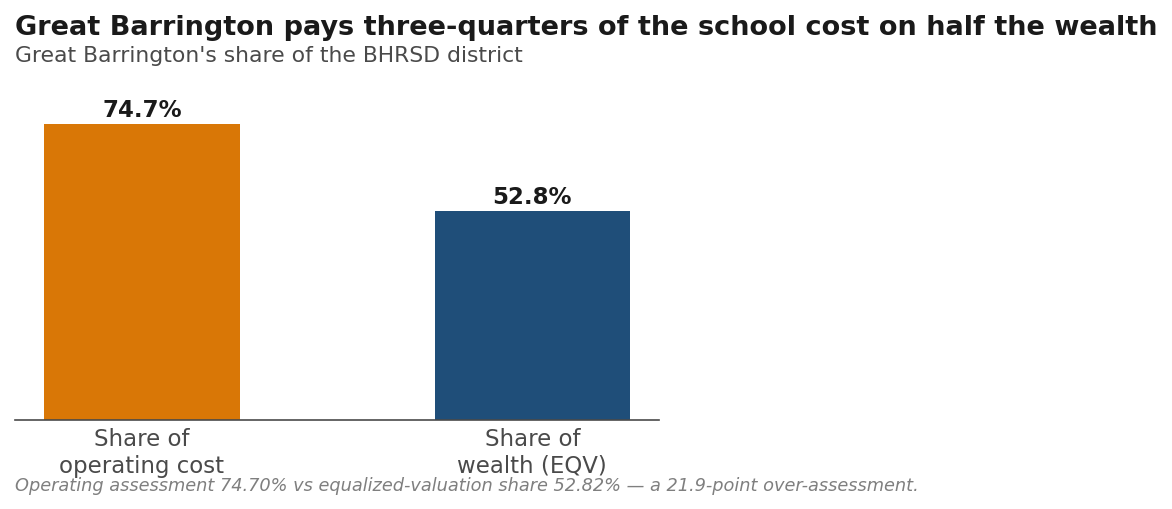
The gap is entrenched, not a recent spike. Across FY16–FY27 Great Barrington’s operating share moved only +4.3 points — it has sat in the low-to-mid 70s the whole time.
But persistence describes the past; it is not a forecast, and the forces underneath the gap are about to push it wider. Stockbridge home prices have roughly tripled since 2010 while local incomes have edged down — pricing year-round families out, thinning Stockbridge’s school enrollment (projected to fall from ~105 students toward ~78 by FY32), and, because operating costs are apportioned by enrollment, pushing Great Barrington’s share up as the small town’s share thins. The same price explosion raises Stockbridge’s share of regional property wealth, widening the very cost-versus-capacity gap the apportionment is meant to track. So the stable history understates the forward problem: left uncorrected, Great Barrington pays a rising share of a rising budget for a shrinking small-town enrollment.
The squeeze — stated precisely
Great Barrington’s property tax levy is capped by Proposition 2½ — it can grow only so much each year. The school assessment is a charge against that capped levy, and it takes a bigger bite of it every year: about 70.6% of the capped operating levy in FY18, 75.3% by FY26, and a projected 83.5% by FY30. Every single percentage point the school’s share climbs pulls roughly $297,000 away from everything else that capped levy has to cover — police, the DPW, the library, town hall.
Two clarifications keep that precise. It does not mean the school is swallowing the whole town budget — measured against all town spending, the rest of Great Barrington’s government has actually grown faster, paid for with money raised outside the cap. And it is not true that “the school grows at twice the levy” — the school’s budget has grown at about 1.2 times the rate of GB’s levy, not two. What is true, and what drives the squeeze, is that the district’s budget grows well above inflation — lately about twice the rate prices rise — while GB’s levy can grow only about 2.5% a year. And the governance is lopsided: Great Barrington pays about 75% of the district’s cost but holds only 50% of the school-committee seats and one of three town votes on any change to the formula — so it can be outvoted by the two smaller towns that together pay about a quarter.
The precedent — the fairness keystone
In 2017 the district itself amended the Regional Agreement to apportion capital costs by property wealth (equalized valuation) instead of enrollment — raising the property-rich small towns’ shares and lowering Great Barrington’s. All three towns approved it, on explicit ability-to-pay grounds. The most striking single fact: Stockbridge — the town that pays the most under wealth-apportionment — approved it 155–91, against its own Finance Committee’s 6–0 recommendation to reject, in the contemporaneous account “with the full awareness that they were taking on a greater tax burden in order to more equally share the costs.”
Three things must travel with that precedent so it is stated accurately:
- The self-sacrifice was the small towns’, not Great Barrington’s. The 2017 change benefited GB (its capital share fell from ~70% to 52.8%), so GB’s near-unanimous support was GB voting for its own interest as well as for a fairer rule. The towns that accepted a heavier burden against their own interest were Stockbridge and West Stockbridge. The honest frame is “the small towns accepted wealth-apportionment against their own interest,” not “Great Barrington led on fairness.”
- The principle, not the magnitude, is what carries over. 2017 was a capital change; its dollar bite arrives now through the new high-school bond. Extending the principle to operating is a larger-dollar move than 2017 was, while a partial floor would be a smaller step than 2017. The principle is identical and already accepted; the size of any operating change is a separate question and should not be blurred with 2017’s.
- Operating is genuinely different, and the towns can say so. The 2017 vote concerned a tangible shared asset (the failing high school). Annual operating costs are recurring, larger, and tied to no single building, and the small towns can reasonably argue the operating side does not follow automatically. The precedent shows the principle is acceptable to these voters; it does not compel the extension. The report’s job is to present the precedent, name the distinction, and let the parties weigh it.
The direction of travel, and the cost of no correction
The movement is toward wealth-based apportionment. The 2017 capital amendment was the first step; Great Barrington voted in both 2017 and 2019 to petition the state to extend the same principle to the operating budget, and the public advocacy for an operating-EQV reform has continued since. The question on the table is not whether to start down this road but whether to take the next step on it.
The district’s budget is not on a sustainable path for the towns funding it. BHRSD operating costs grow about 6% a year — well above inflation, and far above the 2.5% that Proposition 2½ lets Great Barrington’s levy grow. A cost that compounds faster than the revenue available to pay it is, by definition, unsustainable; the only open questions are which town absorbs the strain and for how long. Under the current formula the strain lands hardest on Great Barrington — the least wealthy of the three per capita.
And the unfairness grows on its own — even if the budget never rose. The school bill is split by foundation enrollment — each town’s share of the district’s resident students. Great Barrington’s share has been climbing for decades — it was roughly half the district’s operating assessment in the district’s early years and is about three-quarters today, and still rising. The recent leg alone took it from about 70% a decade ago to about 75% now, and it keeps rising — chiefly because Stockbridge and West Stockbridge are losing students faster than Great Barrington, and partly because Great Barrington shelters the region’s workforce, whose children count in its enrollment. That second thread is where affordability meets apportionment, and it is structural: the workforce housing Great Barrington built is tax-exempt, so the Town cannot levy on it, and its families lift Great Barrington’s enrollment share, so they lift its school assessment — the host town charged for the region’s housing through the formula, the towns that built none charged for neither. The families are not the cost; the structure that isolates that cost on one town is. As the two smaller towns’ share of students falls faster than Great Barrington’s, Great Barrington’s rises, and with it the slice of the budget its already-outsized property wealth over-covers. So even if the district budget were frozen tomorrow, Great Barrington’s over-assessment would keep widening year after year from that shift alone. This is the quiet reason waiting costs Great Barrington more — the inequity compounds by itself — and it is exactly why the correction this chapter points to is pegged to property wealth rather than to a headcount that keeps drifting against the Town: a wealth-based floor holds steady no matter how the enrollments move.
The divergence just described is one edge of the enrollment rule — the small towns shedding students, which lifts Great Barrington’s share. There is a second edge that points forward, and it sharpens the case.
A formula that works against the housing the state is requiring. The school assessment is driven by the number of resident students, so a town that builds family housing raises its own school bill by doing so. That puts the formula in direct conflict with what the state now requires of Great Barrington: as a designated Seasonal Community it must permit smaller lots and additional housing under state law (M.G.L. c.23B §32(e)), and the Affordable Homes Act presses the same way. Great Barrington has already carried much of South County’s affordable-housing load. Under the current formula, every step it takes toward the Commonwealth’s housing goals raises the assessment the headcount rule sends its way — the Town is penalized for doing exactly what the state is asking. A wealth-based apportionment removes that penalty: it shares cost by property wealth, which does not climb simply because a town welcomes more families. The fairness point and the housing point are the same point.
Without a correction, the squeeze forces choices that reach students. As the school assessment climbs toward 83% of Great Barrington’s capped operating levy, the Town’s options narrow to repeated overrides, cuts to municipal services, or pressure back on the school budget itself. None is benign for the district: override fatigue and town fiscal distress are how well-intentioned regional districts end up cutting programs, deferring maintenance, and losing staff. A correction that stabilizes Great Barrington’s contribution is not only fairness for GB taxpayers — it protects the district’s own capacity to deliver for students over the long run. (Stated as the structural risk the figures imply, not a prediction of any specific cut.)
The scenarios — what the table shows
The clearest way to see the apportionment question is in today’s dollars — taking the FY26 budget as a worked example, what Great Barrington pays the school under the current formula and what it would pay under each alternative:
| Apportionment, using FY26 as the example | Great Barrington | Stockbridge | West Stockbridge | GB vs now |
|---|---|---|---|---|
| What GB pays now (enrollment) | $22.4M (74.7%) | $4.0M (13.3%) | $3.6M (12.0%) | — |
| Wealth floor on enrollment (compromise) | $20.1M (67.0%) | $6.3M (21.0%) | $3.6M (12.0%) | ↓ $2.3M |
| Full EQV operating | $15.8M (52.8%) | $9.4M (31.4%) | $4.7M (15.7%) | ↓ $6.6M |
These are the FY26 operating assessments, used here as the worked example — what each town pays the district under the current formula. Percentages are each town’s share. Because the district’s budget grows about 6% a year, the same formula is worth more every year: by FY30 the wealth floor saves Great Barrington about $3.8M and full EQV about $9.1M — the figures the gap analysis uses. (FY26 carries essentially no BHRSD capital; the high-school bond’s capital share phases in FY28–FY30, is already EQV-apportioned, and does not move across these scenarios.) Dissolution — Great Barrington educating its own students — is the extreme alternative, discussed separately below on control grounds rather than dollars.
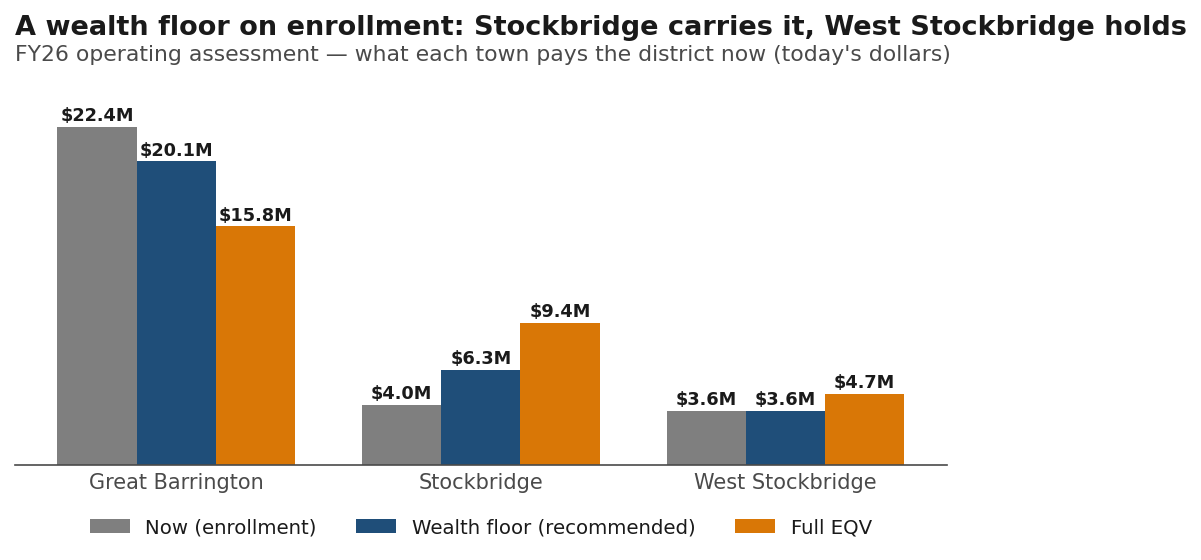
The compromise middle: a wealth floor on top of enrollment. Foundation enrollment stays the base — no town pays less than its enrollment share. On top of it sits a floor scaled to property wealth (EQV): each town pays at least about two-thirds of its wealth share, the ability-to-pay basis all three towns already adopted for capital in 2017. The floor only ever raises a town toward its capacity; it never lowers one below enrollment.
Because the floor is wealth-scaled, it lands almost entirely on the town furthest below its capacity. Stockbridge’s enrollment share (~13%) sits far below its wealth share (31.4%), so the floor lifts it to about 21%. West Stockbridge’s enrollment share (~12%) already exceeds two-thirds of its much smaller wealth share, so the floor doesn’t reach it — West Stockbridge holds exactly where it is. No small town is given relief; the entire correction is carried by Stockbridge, the town that holds the DeSisto and Elm Court upside (projected $2.6–3.7M/yr in new revenue, 64–89% of its entire current school assessment) and roughly twice West Stockbridge’s per-capita wealth. An equal floor would have overcharged West Stockbridge, which has neither the wealth nor the windfall; a wealth-scaled floor asks the town with both to pay closer to its capacity and asks nothing more of the town with neither.
This is deliberately a floor, not a replacement for enrollment apportionment. Enrollment remains how the budget is shared; the floor is a wealth-based minimum that catches only a town paying far below its means. Great Barrington’s relief — about $2.3M in today’s dollars, growing to $3.8M by FY30 — falls out of that rule, and because the floor rests on EQV (hard valuation data, and the 2017 basis) rather than on an enrollment projection, it holds regardless of how the small towns’ enrollments evolve.
Full EQV is the endpoint of the same principle — Great Barrington at its 52.8% wealth share, with the small towns at theirs (West Stockbridge would then rise to 15.7%) — and is also the operating-EQV reform already advocated at the state level; it is the larger move, and the one the small towns face if no negotiated step is taken.
Two developments beyond Great Barrington’s control shape the choice between a negotiated correction and an imposed one. Legislation has been filed on Beacon Hill to base regional-district assessments on property wealth, and a public argument has been advanced that the current formula — under which identical properties in different member towns pay different effective rates for the same public education — is vulnerable to a constitutional equal-protection challenge. Neither is Great Barrington’s to pursue or control; both proceed independently of the Town, and either could move the district toward full equalized-valuation apportionment on terms none of the three member towns sets. That is what makes the wealth floor a genuine compromise rather than a demand — the moderate, member-negotiated middle between today’s formula and a full-EQV outcome the towns may otherwise have decided for them. Accepting the floor is the members’ chance to shape the correction themselves.
Dissolution is the extreme alternative, addressed next on control grounds rather than dollars.
Stockbridge can absorb its share — without raising its year-round residents
The wealth floor asks Stockbridge for about $2.3M more a year today — growing to $3.8M by FY30 as the budget grows. The natural objection — that the increase falls on Stockbridge’s year-round families — does not survive contact with Stockbridge’s own numbers. Stockbridge holds the same toolkit Great Barrington is using in this report, plus a development windfall that its enrollment share does not reflect:
- The windfall alone nearly covers the ask. The DeSisto and Elm Court projects are projected to generate $2.6–3.7M a year in combined property, rooms, and meals revenue at buildout — 64–89% of Stockbridge’s entire current school assessment, and essentially the same magnitude as the floor’s ask. (Potential, not bankable until financing closes and the projects are built — but it is Stockbridge’s to capture, and West Stockbridge and Great Barrington have nothing comparable.)
- Stockbridge under-collects its own personal-property tax. A compliance review of Stockbridge’s second homes identified roughly 247 non-filing parcels and about $134K a year in conservative recovery — the same lever Great Barrington is pulling here, equally available to Stockbridge.
- Stockbridge’s assessments are regressive against modest homes. A striated price study found a Price-Related Differential of 1.34 — well outside the international acceptable band — meaning Stockbridge’s high-value homes are assessed at a lower fraction of market value than its modest homes, shifting burden onto exactly the year-round residents the objection means to protect. Correcting it lowers the median resident’s bill, not raises it.
- Stockbridge is an ideal residential-exemption candidate. Nearly 60% of Stockbridge’s residential value is non-resident-owned (against ~28% in Great Barrington), so a §5C residential exemption there cuts the median year-round resident’s bill by about $1,557 a year at the 35% ceiling — with the cost falling on the non-resident majority. Stockbridge, like Great Barrington, is a designated Seasonal Community eligible for the 50% ceiling.
Taken together, Stockbridge’s own analysis shows the median year-round resident’s bill falling — from about $4,000 today to roughly $3,510 on the compliance and recovery levers alone, and to about $1,988 with the residential exemption added — even as the town absorbs its rising school and capital obligations. A higher BHRSD share for Stockbridge is therefore fundable from the town’s windfall and its own untapped levers, with no tax increase for most of its year-round residents. The floor asks Stockbridge to direct its new capacity toward its fair share of the regional cost — not to tax its families to do it. (Stockbridge figures are from the Parcenomics Stockbridge FY2026 analysis; development revenue is potential, not bankable until built. The point is symmetry — the levers in this report are equally available to Stockbridge, which additionally holds a windfall the other two towns do not. How Stockbridge funds its share is Stockbridge’s decision; this notes only that the capacity plainly exists.)
Dissolution — on the table, with its trade-offs
Withdrawal carries real costs, but it should not be dismissed out of hand: it gives Great Barrington the most direct control of its own education budget, and on the raw arithmetic it is the largest relief on the menu — about $21.6M at FY30, some $10.5M below status quo. But that relief is best read as a question of control, not cost:
- Budget control. Educating its own students at its own appropriation would put the single largest line in the Town’s budget back under Town Meeting’s direct control, rather than a three-town formula GB cannot move alone.
- A credible alternative strengthens every other option. A floor or an EQV step is negotiated in the shadow of the alternatives; an analyzed, costed withdrawal option is leverage at the regional table even if it is never exercised.
Two clarifications keep the dissolution case honest:
- The savings are probably real — which is exactly why this is about control, not cost. It is tempting to discount the headline relief on economies-of-scale grounds, but most school costs are fixed: a teacher costs the same whether the class holds 15 students or 25, and physical plant and administrative overhead do not shrink proportionally in a smaller district. A standalone Great Barrington district would not obviously run at a higher per-pupil cost, so the relief is plausibly close to the raw figure. But that argues against dissolution as a money move: if the dollars are real, they are only modestly larger than a full EQV step, which reaches the same wealth-based share with none of the unwinding. The remaining rationale is control of the school budget — and whether that control is meaningful, or worth the price, is itself uncertain, since the fixed costs, the bond liability, and the educational obligations do not change with the governance structure.
- It is not unilateral. The Regional Agreement requires all three towns plus the Commissioner to approve withdrawal, and a withdrawing town stays liable for its share of outstanding debt — including the new high-school bond — at its locked capital percentage. GB cannot simply leave.
- Regional value would be lost. A shared high school, the committed $152M building, and vocational and specialized programming that only regional scale sustains would have to be replaced or forgone.
- Student-outcome risk. Dissolution is the highest-variance path for students: a smaller standalone district means a thinner course catalog, fewer specialized staff, and less capacity to absorb enrollment swings. The control gain has to be weighed against that educational risk, not just the dollars.
The honest framing: dissolution is a control play, not a cost play. Its dollar edge over a negotiated EQV step is modest, and it is bought at high execution risk, continued bond liability, lost regional programming, and real student-outcome risk. The floor and EQV steps are lower-risk, in-district corrections that capture most of the same relief; dissolution’s distinct value, if any, is direct budget control — uncertain enough that its main practical use is as the analyzed alternative that makes the negotiated steps credible.
The timing favors acting now
One piece of context belongs alongside the ask. The rules governing how Massachusetts funds schools and splits regional-district costs are themselves under active state review right now — so a correction pursued today enters a moment when these questions are being reopened, not a settled one. And the concern the state is examining is the same one this chapter identifies: that the formula leans too heavily on student headcount and works against districts whose enrollment is shifting. A town making the cooperative case now is pushing on a door the Commonwealth has already begun to open. (In its FY2026 budget the Legislature commissioned a Chapter 70 Local Contribution Study — carried out by the Department of Elementary and Secondary Education and the Division of Local Services — that examined how the school-funding formula treats property wealth, its effect on municipal services, and the particular challenges of rural and regional districts; and in July 2026 the Governor’s FY2027 budget revived the Foundation Budget Review Commission to re-examine the K–12 funding formula, with education officials pressing the over-reliance on enrollment counts. Stated as timing context, not a prediction of any outcome.)
BHRSD Apportionment — The ownable workstream
| Who acts | Apportionment is set by the Regional Agreement; amending it requires all three towns by town-meeting vote plus the Commissioner. Great Barrington cannot move it unilaterally. The town’s shared assignment is to carry the cost-versus-capacity case and the 2017 precedent into the regional conversation. |
| The shared bucket | The trilateral cost-vs-capacity table, the FY30 scenario model, and the 2017-precedent brief — the evidentiary package for the regional table. This is the one chapter that is not any one policymaker’s to own. |
| Sequence | The longest horizon of all. A Regional Agreement Amendment Committee → all-towns town-meeting votes → the Commissioner. The local levers (1–9) are what Great Barrington controls while this plays out. |